How to choose a marketing WordPress theme that converts

By Shehzad Hussain · Last updated: November 2026
Marketing themes make a promise most themes do not: not just a good-looking site, but a site that turns visitors into enquiries, signups or sales. That promise is easy to print on a demo and hard to verify, because conversion depends on the offer, the audience and the traffic as much as on the design. Still, some themes genuinely convert better than others, and the difference comes down to how they handle the moments where a visitor decides.

Conversion is a sequence, not a button
Visitors do not arrive ready to convert. They arrive curious, sceptical, or half-distracted, and the site has to move them through stages: understand the offer, believe it, want it, and act. A theme that converts well supports each stage. The offer must be statable in one clear headline. Belief must be supported by proof placed near the claim, not on a separate page. Desire must be fed by specifics about outcomes, not adjectives. Action must be available at the moment desire peaks, not only at the bottom of the page.
When evaluating themes, trace that sequence through the demo. Can you state the offer in the hero without a paragraph of explanation? Is there proof — results, clients, numbers you can stand behind — within the first screen or two? Is the primary action visible at every stage, or does it vanish once the visitor scrolls past the hero? Themes that pass this trace tend to look less dramatic than conversion-themed demos full of popups, and they convert better in practice.
Landing pages are where conversion happens
Most conversions happen on landing pages built for a specific campaign, audience or offer, not on the homepage. A marketing theme should therefore make landing pages quick to build and easy to vary: duplicate a proven layout, change the headline and offer, publish, and measure. Themes that require a developer for every landing page variant will slow campaign work to a crawl, and marketing teams will stop testing, which is the real conversion killer.
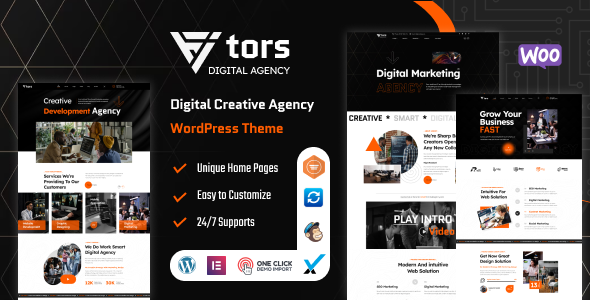
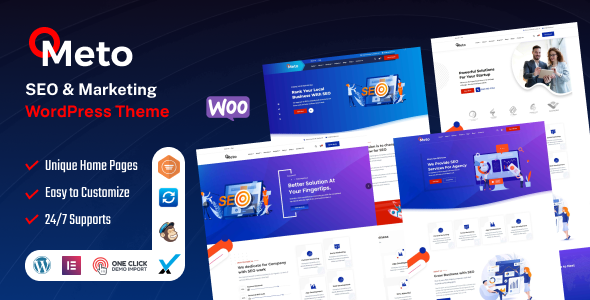
Landing pages also need restraint. Remove navigation, secondary links and anything else that competes with the single action the page exists for. A theme that supports clean, focused landing templates — and lets you keep the main site’s full navigation elsewhere — gives campaigns their best chance. The marketing themes in the catalogue, including Moxes for SEO and agency promotion, Vitors for digital agency presentation, and Meto for SEO and marketing layouts, all provide service and landing structures built around enquiry generation.
Speed is a conversion feature
Every second of loading time costs conversions, and the effect is steepest on mobile, where most marketing traffic arrives. Marketing themes are often the worst offenders, loaded with sliders, animations and tracking scripts that delay the content visitors came for. Test candidate themes on a throttled mobile connection with a real landing page, not the demo’s lightest page, and measure time to first meaningful content rather than total load time. A theme that shows its headline and form quickly will out-convert a prettier theme that keeps visitors waiting.
Forms deserve the same scrutiny. Each field costs completions, so a marketing theme should support short forms with clear labels and a confirmation that says what happens next. Asking for a phone number before earning trust, or hiding the submit button below the fold, are conversion mistakes that no amount of design polish fixes.
Proof must be specific and honest
Marketing sites live on proof, and vague proof is worse than none. Testimonials should name the client type and the outcome. Case studies should describe the starting point and the result. Statistics should be ones you can defend. A theme with flexible testimonial and results layouts helps you present proof well, but the honesty of the proof is your responsibility, and visitors in 2026 are well practised at spotting inflated claims. One credible case study outperforms a page of generic praise.
Measure, then improve
The final requirement of a converting theme is that it lets you learn. Every landing page should be measurable: visits, form starts, form completions, and downstream enquiries. Review those numbers regularly and change one thing at a time — a headline, a form length, a proof placement — so you know what worked. A theme that makes measurement and iteration easy will keep improving after launch, and that compounding improvement is what separates a site that converts from a site that merely looks like it should.
Testing headlines without guessing
Marketing teams often debate headlines endlessly, when the cheaper answer is to test them. A simple headline test — two versions of a landing page, traffic split between them, conversions measured — settles arguments that meetings never will. The discipline is to change one element at a time and to run the test long enough for a meaningful result. Changing the headline, the image and the form at once tells you nothing, because you cannot tell which change moved the number.
Start with the highest-traffic pages, where tests reach conclusions fastest, and keep a record of what you tested and what you learned. Over months, that record becomes a genuine understanding of your audience: which promises they respond to, which proof they trust, which offers they act on. A theme that makes landing page variants quick to build and measure supports this habit. The habit itself — testing instead of guessing — is what separates marketing sites that improve from marketing sites that merely get redesigned every few years.
The themes in this post, compared
Every theme below is named in the article itself. The post does not quote prices, so check the product page for the current price.
| Theme | Format | What the post says about it | Price noted in the post |
|---|---|---|---|
| Moxes | WordPress theme | The marketing themes in the catalogue, including Moxes for SEO and agency promotion, Vitors for digital agency presentation, and Meto for SEO and marketing layouts, all provide service and landing structures built around enquiry generation. | See the product page |
| Meto | WordPress theme | Meto for SEO and marketing layouts, all provide service and landing structures built around enquiry generation. | See the product page |
| Vitors | WordPress theme | The marketing themes in the catalogue, including Moxes for SEO and agency promotion, Vitors for digital agency presentation, and Meto for SEO and marketing layouts, all provide service and landing structures built around enquiry generation. | See the product page |
Frequently asked questions
Why does the post emphasise conversion is a sequence, not a button for marketing WordPress theme that converts?
Visitors do not arrive ready to convert. They arrive curious, sceptical, or half-distracted, and the site has to move them through stages: understand the offer, believe it, want it, and act. In practice, that means judging a WordPress theme on this point before you buy, not after the site is built — open the live demo, find the section the post describes, and check it with your own content in place.
What makes Moxes a good fit for a marketing WordPress theme that converts?
The marketing themes in the catalogue, including Moxes for SEO and agency promotion, Vitors for digital agency presentation, and Meto for SEO and marketing layouts, all provide service and landing structures built around enquiry generation. That is the post’s own judgement, and it is worth verifying against the live demo: check the Moxes demo with your own images and copy, because a theme that looks right with stock content can feel different with yours.
What makes Meto a good fit for a marketing WordPress theme that converts?
Meto for SEO and marketing layouts, all provide service and landing structures built around enquiry generation. That is the post’s own judgement, and it is worth verifying against the live demo: check the Meto demo with your own images and copy, because a theme that looks right with stock content can feel different with yours.
How much should I budget for a marketing WordPress theme that converts?
The post does not quote a price for marketing WordPress theme that converts, so treat the theme as one line in a small budget, not the whole budget. As a guide, WordPress themes on Expert Themes are listed at $20 and HTML templates at $10, with hosting and a domain on top. Check the product page for the current price before you decide, and count any paid plugins you will need.
Will a marketing WordPress theme that converts work properly on a phone?
Every second of loading time costs conversions, and the effect is steepest on mobile, where most marketing traffic arrives. The post treats mobile as a first check rather than an afterthought, and that is the right order: most visitors in this niche arrive on a phone, so open the demo on your own phone and test the menu, the forms, and the main call to action before you buy.
This is general guidance for choosing in this niche, not a guarantee: a theme that scores well on a demo can still slow down once your own images, plugins, and tracking are added. Test any marketing WordPress theme that converts with your real content before you commit.
Sources
- WordPress.org — Theme Handbook: theme requirements and review guidelines (accessed November 2026)
- Expert Themes — Moxes product page (accessed November 2026)
- Expert Themes — Meto product page (accessed November 2026)
- ThemeForest — Expert Themes seller page, member since July 2016 (accessed November 2026)