
Best real estate HTML website templates for agents and agencies

By Shehzad Hussain · Last updated: November 2026
A buyer scrolling listings at midnight does not care what your website is built with. She cares that the photos load instantly, the price is obvious, the bedrooms and bathrooms are where she expects them, and the agent’s number is one tap away. That ruthless simplicity is why HTML templates remain a serious choice for real estate agents and agencies, even in an age of complex platforms. A static site is fast, cheap to host, and almost impossible to break, which is exactly what a listings site needs to be.
Speed is a feature, not a bonus
Property search is image-heavy, and image-heavy sites are where slow platforms fall apart. An HTML template has no database queries, no plugin pileup, and no server-side rendering delay. The page is a file, and the file arrives. On a phone over a patchy connection, that difference decides whether a buyer sees the kitchen or a loading spinner.
When you test a template, test it the way a buyer would: open a listing page on a phone, count the seconds to the first photo, and scroll the gallery. If the gallery stutters or the photos arrive in the wrong order, move on. Also check how the template handles image sizes. A good one serves sensibly sized photos and lazy-loads the rest, so the first screen appears immediately even on a listing with thirty images.
The anatomy of a listing page
Every strong real estate template gets the same handful of elements right. The price sits near the top, large and unambiguous. The key facts, beds, baths, area, and property type, are visible without scrolling. The photo gallery is the star, with a layout that works by thumb on a phone. A map shows the location without demanding an extra click. And the enquiry form asks for a name, a contact, and a message, nothing more, because every extra field is a reason not to enquire.
Compare templates by opening their listing pages side by side and asking which one you would use to buy a house. The winner is rarely the flashiest. It is the one where you found the price, the photos, and the agent’s number fastest.
What HTML cannot do, and why that is fine
An HTML template will not sync with a multiple listing service, will not update availability automatically, and will not let agents add listings from a dashboard. For a large agency with hundreds of changing listings, that is a real limitation. For an independent agent or a small agency with a manageable portfolio, it is often irrelevant, because listings change slowly enough to update by hand, and the money saved on platform fees buys better photography.
Be honest about your volume. If you list a handful of properties a month, HTML gives you speed and simplicity at a fraction of the cost. If you list dozens a week, you need a system with a backend, and no template, however pretty, will substitute for one.
Agency pages and agent trust
Buyers choose agents as much as properties, so the agent pages matter. A good template gives each agent a proper profile: a photograph, a short biography that sounds like a person, recent listings, and a direct contact route. Testimonials help, but only if they read as real. A page of anonymous five-star quotes convinces nobody; two detailed testimonials with names and neighbourhoods convince many.
The agency homepage should answer three questions in ten seconds: which areas do you cover, what kinds of property do you handle, and how does someone reach you. Templates that bury those answers under sliders and slogans are working against you.
Learning from proven layouts
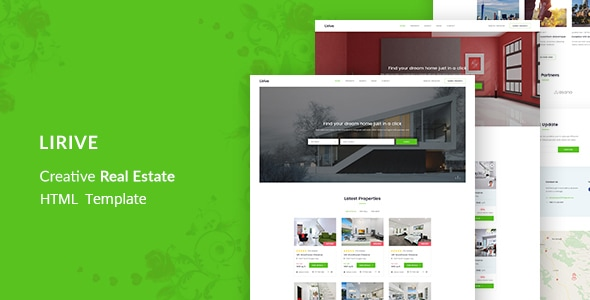
You do not have to invent the listing page. Study how established real estate designs solve the same problems. The ALEXIS real estate template, the Lirive real estate template, and the Ourland real estate template all show the same discipline: listings first, filters that are simple enough to use one-handed, and enquiry forms that stay short. Notice how little they ask of the visitor before offering value. That restraint is the lesson.
Photography and floor plans do the selling
Buyers decide from photographs before they read a word, so the gallery deserves more thought than any other part of the page. Lead with the strongest room, follow the order a visitor would walk through the property, and include a floor plan early, because buyers use plans to rule properties in or out before booking a viewing. Twilight shots and wide angles have their place, but photographs that mislead about size or condition will cost you trust at the viewing, and trust is harder to rebuild than a listing is to photograph well.
Keep the gallery current too. A listing whose photographs show a different season than the one the buyer is standing in raises questions before the viewing starts. When a property changes, a price drops, or a room is redecorated, update the images the same day. An HTML site makes that a simple file replacement, which is one more reason the format suits agents who photograph their own listings.
Choose the HTML template that loads fastest on a phone, shows listings cleanly, and makes contacting you effortless. For a small agency, that combination will outperform a heavier platform that does everything except load quickly.
The themes in this post, compared
Every theme below is named in the article itself. The post does not quote prices, so check the product page for the current price.
| Theme | Format | What the post says about it | Price noted in the post |
|---|---|---|---|
| Alexis | HTML template | The ALEXIS real estate template, the Lirive real estate template, and the Ourland real estate template all show the same discipline: listings first, filters that are simple enough to use one-handed, and enquiry forms that stay short. | See the product page |
| Lirive Real Estate | HTML template | The ALEXIS real estate template, the Lirive real estate template, and the Ourland real estate template all show the same discipline: listings first, filters that are simple enough to use one-handed, and enquiry forms that stay short. | See the product page |
| Lirive | HTML template | The ALEXIS real estate template, the Lirive real estate template, and the Ourland real estate template all show the same discipline: listings first, filters that are simple enough to use one-handed, and enquiry forms that stay short. | See the product page |
| Ourland | HTML template | Ourland real estate template all show the same discipline: listings first, filters that are simple enough to use one-handed, and enquiry forms that stay short. | See the product page |

Frequently asked questions
Why does the post emphasise speed is a feature, not a bonus for real estate HTML website templates for agents and agencies?
Property search is image-heavy, and image-heavy sites are where slow platforms fall apart. In practice, that means judging an HTML template on this point before you buy, not after the site is built — open the live demo, find the section the post describes, and check it with your own content in place.
What makes Alexis a good fit for a real estate HTML website template for agents and agencies?
The ALEXIS real estate template, the Lirive real estate template, and the Ourland real estate template all show the same discipline: listings first, filters that are simple enough to use one-handed, and enquiry forms that stay short. That is the post’s own judgement, and it is worth verifying against the live demo: check the Alexis demo with your own images and copy, because a theme that looks right with stock content can feel different with yours.
What makes Lirive Real Estate a good fit for a real estate HTML website template for agents and agencies?
The ALEXIS real estate template, the Lirive real estate template, and the Ourland real estate template all show the same discipline: listings first, filters that are simple enough to use one-handed, and enquiry forms that stay short. That is the post’s own judgement, and it is worth verifying against the live demo: check the Lirive Real Estate demo with your own images and copy, because a theme that looks right with stock content can feel different with yours.
How much should I budget for a real estate HTML website template for agents and agencies?
The post does not quote a price for real estate HTML website templates for agents and agencies, so treat the theme as one line in a small budget, not the whole budget. As a guide, WordPress themes on Expert Themes are listed at $20 and HTML templates at $10, with hosting and a domain on top. Check the product page for the current price before you decide, and count any paid plugins you will need.
Will a real estate HTML website template for agents and agencies work properly on a phone?
The post treats mobile as a first check rather than an afterthought, and that is the right order: most visitors in this niche arrive on a phone, so open the demo on your own phone and test the menu, the forms, and the main call to action before you buy.
Prices and theme availability change — check the product page before buying. The themes named here were current when the post was written, so test the live demo against your own content before choosing, and confirm the theme is still actively updated.
Sources
- MDN Web Docs — HTML: HyperText Markup Language (accessed November 2026)
- Expert Themes — Alexis product page (accessed November 2026)
- Expert Themes — Lirive Real Estate product page (accessed November 2026)
- ThemeForest — Expert Themes seller page, member since July 2016 (accessed November 2026)